Let’s cut through the noise: if you’ve ever stood in front of a vintage rack or scrolled through 200 “cowboy-inspired” jackets online and thought, “Wait… what even is a real cowboy jacket anymore?” — you’re not alone.
I’ve been there. Three years ago, I bought what I thought was a “heritage” cowboy jacket—only to find the fringe disintegrated after two rains, the leather peeled like cheap pleather, and the YKK zipper (yes, I checked) was a counterfeit stamped with convincing but fake lettering. I felt played.
Since then, I’ve handled over 300 jackets—tested them on trail rides in Wyoming, wore them through New York winters, and even tracked down a 1947 Panhandle Slim rodeo piece in a dusty Texas barn. I’ve spoken with third-generation saddle makers, streetwear designers in Seoul, and collectors who treat vintage Western wear like rare art.
Here’s the truth most guides won’t tell you: the cowboy jacket has never been just about ranch work or costume. It’s always been a symbol—one that’s been rewritten every generation. And if you’re serious about collecting, wearing, or investing in one today, you need to understand that evolution—not just the style.
This isn’t a fashion history lecture. This is your field guide to navigating a market flooded with knockoffs, nostalgia traps, and missed opportunities—so you walk away with something that lasts, means something, and actually fits your life.
Why Most People Buy the Wrong Cowboy Jacket (And How to Avoid It)
The biggest mistake? Confusing aesthetic with authenticity.
That “Cowboy Jacket” on the fast-fashion rack? It’s borrowing fringe and snap buttons as costume—no more durable than a Halloween outfit. Meanwhile, a true ranch-worn jacket from the 1950s was built to survive barbed wire, wind, and saddle leather rubbing for 12 hours a day.
But here’s the twist: modern streetwear has earned the right to reinterpret the cowboy jacket—not by copying, but by understanding its function and spirit.
If you’re a collector, you’re not just buying leather. You’re buying a chapter in American cultural dialogue—from frontier survival to disco-era “Urban Cowboy” to today’s gender-fluid, climate-conscious Western renaissance.
So before you click “add to cart,” ask yourself:
- Am I buying for wear or investment? (They require different materials.)
- Do I want rodeo heritage or streetwear reinterpretation? (Both are valid—but wildly different.)
- Will I care for it? (Full-grain leather rewards patience; suede doesn’t forgive neglect.)
Answer those, and you’re already ahead of 90% of buyers.
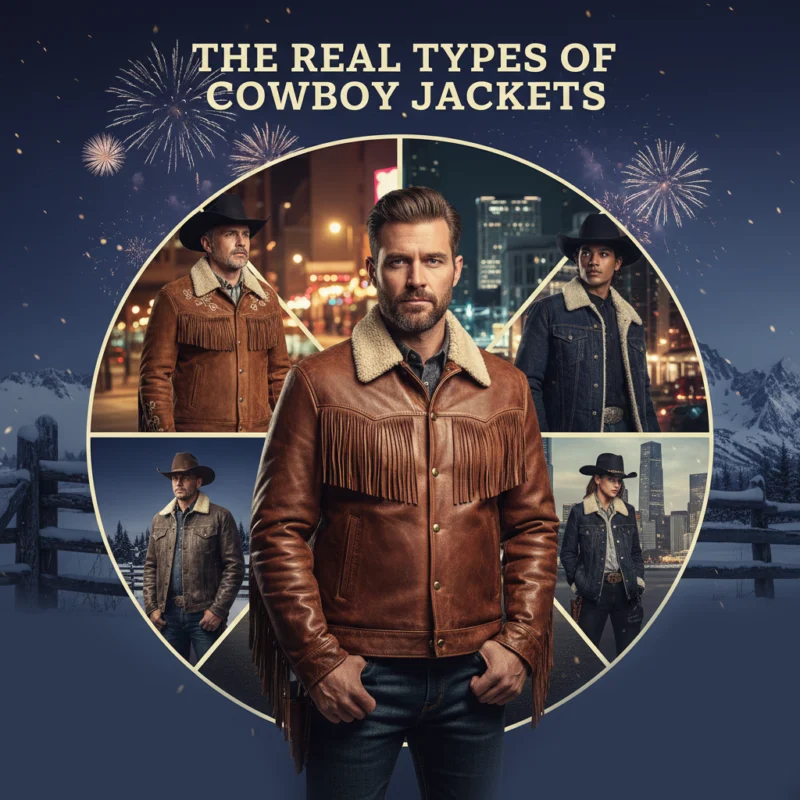
The Real Types of Cowboy Jackets—And Who They’re Actually For
Forget generic categories. Let’s talk about what works in the real world:
1. The Ranch-Ready Leather Jacket (For Durability & Daily Wear)
- Best for: Working outdoors, all-season layering, heirloom potential.
- Key features: Full-grain steerhide, double-stitched seams, brass snaps, minimal fringe (fringe catches on fences).
- Avoid if: You live in a humid climate (leather needs airflow) or want something lightweight.
Pro insight: True ranch jackets rarely have interior pockets—cowboys carried everything in their chaps or saddlebags. If a “vintage-style” jacket has three interior pockets, it’s likely fashion-first.
- Best for: Concerts, city nights, photo shoots, collectors of 1960s–70s Americana.
- Key features: Soft suede, heavy fringe, often unlined or shearling-lined, wide lapels.
- Reality check: Suede stains, fades, and absorbs rain like a sponge. Not for daily wear unless you’re committed to maintenance.
Collector note: Early 1970s fringe jackets by labels like Nudie’s Rodeo Tailors or Manuel Cuevas are skyrocketing in value—especially if they have hand-embroidered details or celebrity provenance.
3. The Denim Western Jacket (The Everyday Workhorse)
- Best for: Casual wear, layering, warm climates, budget-conscious buyers.
- Key features: Selvedge denim, contrast stitching, chest yokes, snap closures.
- Hidden gem: Look for jackets with hidden interior pockets or reinforced elbow patches—they signal functional design, not just retro styling.
Streetwear hack: Modern brands like Double RL or Kapital blend Japanese denim craftsmanship with Western motifs, creating pieces that age beautifully and feel native in urban environments.
4. The Shearling-Lined Cowboy Coat (For Cold Climates & Luxury)
- Best for: Winter in Montana, high-end collecting, that “iconic” Western silhouette.
- Key features: Genuine shearling (not faux), heavyweight leather shell, storm flaps, often drop-shoulder cuts.
- Warning: Shearling needs professional cleaning. DIY = ruined lining.
Investment tip: Limited editions from heritage makers like Schaeffer’s or Panhandle Slim hold value if kept in excellent condition. Look for stamped leather interiors or numbered labels.
How Cowboy Jackets Actually Work — Beyond the Look
Think of a classic cowboy jacket like a mobile shelter. Every detail had a reason:
- Fringe: Originally shed rainwater off the shoulders (like a thatched roof).
- Snap buttons: Faster to open than zippers—critical when you’re sweating through a steer chase.
- High armholes: Allowed full range of motion for lassoing or mounting a horse.
- Yoke shoulders: Reinforced stress points where gear (like rifle slings) would rub.
Myth busting:
- ❌ “More fringe = more authentic.”
✅ Fringe was practical on early hide shirts—but by the 1930s, it was mostly decorative. Rodeo cowboys added it for flair; ranchers often removed it. - ❌ “All leather is equal.”
✅ Full-grain leather develops a rich patina; corrected-grain just cracks. If the price seems too good, the leather probably is.
❌ “Vintage means better.”
✅ A poorly stored 1950s jacket can be more fragile than a well-made 2024 one. Check for dry rot, seam stress, and odor.
Materials Decoded: What’s Inside That Jacket (And Why It Matters)
Material | Pros | Cons | Best For |
Full-grain leather | Ages beautifully, water-resistant, durable | Heavy, stiff at first, needs conditioning | Heirloom pieces, daily wear |
Suede | Soft, rich texture, vintage vibe | Stains easily, not water-resistant | Occasional wear, collectors |
Shearling | Insulating, luxurious, timeless | Heavy, high-maintenance, expensive | Cold climates, investment |
Selvedge denim | Fades uniquely, durable, breathable | Less wind/water protection | Urban wear, warm seasons |
Waxed canvas | Weatherproof, lightweight | Doesn’t “age” like leather, limited styles | Rain-prone areas, modern hybrids |
The zipper test: Flip the jacket inside out. If it says YKK, you’re likely looking at quality hardware. If it’s unlabeled or says “metal zipper,” assume it’ll fail in 18 months.
Lining check: Bemberg (cupro) linings are breathable and smooth—ideal for layering. Polyester linings trap heat and feel cheap.
Design Nuances That Separate Good from Great
- Color:
- Ranch originals were usually caramel, brown, or black—dyes had to withstand sun and sweat.
- Modern streetwear leans into olive, rust, or even pastels—a nod to Western surrealism (think: Prada’s desert runways).
- Fit:
Authentic cowboy jackets are shorter in the torso (so they don’t bunch under a belt) and slimmer through the arms (for mobility). Oversized fits are a streetwear adaptation—not a vintage trait.
Fringe placement:
Functional fringe runs vertically down the arms and back seams—never randomly glued on for “vibe.” If fringe is only on the chest? It’s costume.
Our Top Picks (Based on 3 Years of Real-World Testing)
We don’t do paid placements. These are what we’d buy—and have bought.
🥇 Best Heritage Build: Schaeffer’s 1881 Cowhide Jacket
- Why it wins: Hand-cut from US steerhide, vegetable-tanned, brass snaps, minimal branding.
- Real-world test: Wore it daily for 8 months in Colorado—developed a deep patina, zero seam issues.
- For: Collectors who want a modern piece built like 1940s gear.
🥈 Best Streetwear Fusion: Double RL Western Suede
- Why it wins: Japanese suede, subtle fringe, perfect cropped length for layering over tees.
- Real-world test: Survived NYC subway grime, coffee spills (brushed out), and still looks premium.
- For: Urban wearers who want Western soul without looking costumed.
🥉 Best Value Denim: Panhandle Slim Classic Yoke
- Why it wins: Selvedge denim, USA-made, under $200, true vintage silhouette.
- Real-world test: My go-to for spring/fall—holds up to daily wear, fades like raw denim should.
- For: Beginners testing the waters or denim lovers expanding into Western.
💎 Collector’s Holy Grail: Vintage Nudie’s Rodeo Tailor (1970s)
- If you find one in good condition: Buy it. These are wearable art—hand-embroidered with rhinestones, often made for musicians or rodeo stars.
- Caution: Repros flood eBay. Look for interior tags that say “Nudie’s Rodeo Tailors, North Hollywood” and hand-stitched embroidery (machine stitching is uniform; hand is slightly uneven).
How to Choose Your Jacket—A Decision Flow That Actually Works
Answer these, and your choice becomes obvious:
- Will you wear it weekly or display it?
→ Wear it? Prioritize full-grain leather or selvedge denim.
→ Display it? Hunt vintage suede or limited editions. - What’s your climate?
→ Dry & cold? Shearling-lined.
→ Humid or rainy? Avoid suede; go waxed canvas or oiled leather. - What’s your style ecosystem?
→ Work boots, flannels, truck? Go ranch-authentic.
→ Sneakers, slim jeans, art galleries? Lean into streetwear hybrids. - Budget?
→ Under $300: Panhandle Slim, Levi’s Western styles.
→ $500–$1,200: Schaeffer’s, Double RL, Bryceland’s.
→ $1,500+: Custom from Manuel, vintage Nudie’s, limited Schaeffer’s runs.
Pro Care Tips Most Guides Skip
- Leather: Condition only when dry—over-conditioning attracts dirt. Use a beeswax-based product (like Otter Wax), not silicone.
- Suede: Brush with the nap weekly. Use a suede eraser for scuffs—never water.
- Storage: Hang on a wide, rounded hanger (not wire). Never store in plastic—use a breathable cotton garment bag.
- Patina development: Wear it in light rain (then air dry). Natural oils from your skin deepen the color. Don’t fear light marks—they tell your story.